"I Spent $12,000 on Under-Eye Fillers. Here's What I Wish I'd Done Instead."
After five years of chasing smoother skin under the needle, one woman discovers the at-home device that works at the same biological depth — without the cost, the bruising, or the fear.

The first time I walked into a medical spa in my early forties, I told myself it was a one-time thing.
I had noticed it a few months earlier — that particular hollowness under my eyes that no amount of sleep or concealer could fix. My dermatologist called it "tear trough volume loss." I called it the moment my face stopped looking like mine. So I booked a consultation, listened to a very confident woman in a white coat explain how hyaluronic acid filler would restore exactly what I'd lost, and walked out of the office $980 lighter — with two tiny puncture marks and a bruise the size of a nickel on each cheek.
And honestly? It worked. For about eight months, it genuinely worked.
Then the filler started to migrate.
The Part Nobody Puts in the Brochure
Filler migration under the eyes is more common than the industry likes to admit. The tissue there is uniquely thin and delicate — the kind of territory where a syringe needle is a blunt instrument, not a scalpel. By month ten, I noticed a subtle puffiness that wasn't there before, sitting just below where the filler had been placed. My injector called it "product displacement." I called it spending another $700 to try to fix it.
I wish I could tell you that was the end of the story. It wasn't.
"I had let a pattern calcify in my life: twice a year, like clockwork, I would hand over a thousand dollars to feel like myself again for a few months — and then watch it slowly fade and distort."
Over five years, I had seven separate filler appointments across three different providers — each one promising better technique, better product, better placement. Some sessions were genuinely good. Others left me hiding behind oversized sunglasses for two weeks. One left me with a lump that took three months and a round of hyaluronidase injections to dissolve. That appointment, the dissolving one, cost me an additional $350 and achieved the net effect of erasing $1,200 worth of work I'd already paid for.
I was on the treadmill. I just hadn't admitted it yet.

The Real Math of 5 Years Under the Needle
I rounded down to $12,000 when I tell this story because the exact number makes me feel a little sick. The honest number, once I pulled five years of credit card statements, was closer to fifteen grand. That's a used car. That's a semester of college tuition. That's what I spent chasing the version of my face I had at 38.
Why Fillers Are the Wrong Solution to the Right Problem
Here's what I understand now that I wish someone had explained to me at that first consultation: under-eye aging is not primarily a volume problem. It's a structural problem. It's a collagen problem. It's a muscle tone and lymphatic drainage problem. Filler addresses exactly one of those things — volume — and it does so by stuffing a foreign substance into an area that has grown hollow because its scaffolding has deteriorated.
Imagine your skin as a mattress. Over time, the internal springs weaken, the foam compresses, the whole structure sags. Filler is like stuffing pillows into the mattress from the outside — it can temporarily puff it back up, but the springs are still broken. The foam is still degraded. And the pillows tend to shift.
What I actually needed, and what I had no idea was achievable without a $5,000 clinical laser treatment, was something that would work at the cellular level — restoring the biological machinery that had quietly stopped functioning so efficiently in my forties.
The periorbital area (around the eyes) has the thinnest skin on the face — approximately 0.5mm, compared to 2mm elsewhere. This extreme thinness, combined with constant mechanical movement from blinking (~15,000 times per day), makes it the first region to show:
- Collagen degradation: Fibroblast activity naturally declines with age, reducing the new collagen your skin produces to replace what breaks down.
- Orbicularis oculi atony: The ring muscle surrounding the eye loses tone over time, contributing to both wrinkling and under-eye hollowing.
- Lymphatic sluggishness: Reduced microcirculation allows fluid and metabolic waste to pool, creating the chronic puffiness and dark tone that no concealer fully corrects.
The Number That Changed My Thinking
2 to 3 millimeters.
That's the depth at which collagen synthesis happens — where your fibroblasts live, where the structural proteins are built, where the actual work of skin repair takes place. Clinical red light therapy, specifically wavelengths in the 630–660nm range, has been documented in peer-reviewed literature to penetrate to exactly that depth and stimulate fibroblast activity by energizing mitochondria to produce more ATP — essentially giving your skin cells the fuel they need to do their jobs.
I had heard of red light therapy in passing. I associated it with those enormous expensive panels that influencers stood naked in front of. I had no idea that targeted, at-home devices had become sophisticated enough to deliver clinical-range wavelengths to the precise tissue layer where they're actually useful — and that combining them with EMS microcurrent could simultaneously address muscle tone and lymphatic drainage.
I had no idea something like RevitalEyes existed.

Currently 50% off — the RevitalEyes device from Botanique Paris is $79.95 (was $159.99). Backed by a full 365-day money-back guarantee.
See the RevitalEyes Device →Finding RevitalEyes (and Finally Understanding the Technology)
A friend forwarded me an article last fall. She's a former RN, someone I trust to cut through wellness marketing nonsense, and her message was short: "I bought this for my mom. You should read about what it actually does."
The device is called RevitalEyes, made by a French skincare brand called Botanique Paris. It's a handheld, eye-contour wand that combines two distinct mechanisms in a single pass: 630–660nm Red Light Therapy and EMS Microcurrent.
The red light component works at the subdermal level I described — penetrating 2 to 3mm to reach the fibroblast layer, where it triggers mitochondrial ATP production. More ATP means more energy available for collagen synthesis and cellular repair. This is not cosmetic marketing language; it's a mechanism that's been studied in the context of wound healing and dermatology for decades.
The EMS microcurrent component does something different and complementary. Tiny electrical pulses — completely imperceptible at the skin surface — stimulate the orbicularis oculi, the ring muscle that circles the eye. Think of it as a passive workout for the muscle that holds your under-eye structure in place. Over consistent use, the muscle develops better tone, which translates to improved structural support for the overlying skin. The microcurrent also stimulates lymphatic drainage, which directly addresses the pooling that creates chronic puffiness and dullness.
"It wasn't replacing what fillers did. It was addressing what fillers never touched — the actual biological decline that makes the under-eye area look aged in the first place."
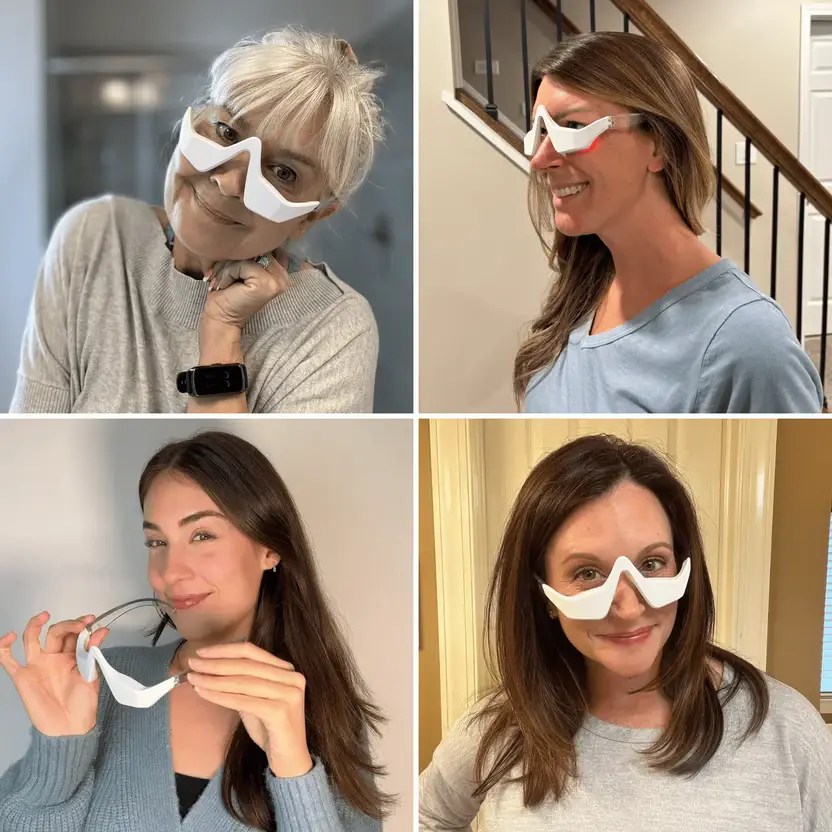
I started using it in October. Ten minutes per eye, every evening before bed, working the wand along the orbital bone the way the instructions described. By week three, my husband — who has never once commented on my skincare routine in eighteen years of marriage — asked if I'd been sleeping better.
I hadn't changed anything about my sleep. I'd changed what I was doing under my eyes.
Twelve Weeks Later
I want to be honest about what this device does and what it doesn't do, because I am done being sold fantasies.
It does not produce results in 48 hours the way a fresh syringe of filler does. The mechanism is biological — you are asking your body to rebuild tissue, which takes time. The first visible changes I noticed were in puffiness and tone, around weeks two through four. The deeper changes — the texture improvement, the reduction in the fine crepiness that had developed — became apparent around weeks eight through ten.
What it produced, by week twelve, was something filler never gave me: results that looked like my face. Not a filled face. Not a slightly puffy face with smooth skin sitting on top. My face, with better collagen, better structure, and none of the anxiety I used to carry about what would happen when the product started to migrate.
I had my last filler appointment 14 months ago. I have no plans to book another one.

Under-Eye Fillers vs. RevitalEyes
A side-by-side look at the two approaches across the metrics that actually matter
| Category | Hyaluronic Acid Fillers | RevitalEyes Device |
|---|---|---|
| Upfront Cost | $800–$1,600 per session | $79.95 (one-time) |
| Annual Cost | $1,600–$4,800 (2–3 sessions/yr) | $0 after purchase |
| 5-Year Cost | $8,000–$24,000+ | $79.95 |
| Addresses Collagen Loss | ✗ No — volume only | ✓ Yes — stimulates fibroblasts |
| Improves Muscle Tone | ✗ No | ✓ Yes — EMS microcurrent |
| Addresses Lymphatic Drainage | ✗ No | ✓ Yes |
| Migration Risk | ✗ Real & documented risk | ✓ None |
| Bruising / Downtime | ✗ Common — 1–2 weeks | ✓ None |
| Results Look Natural | Variable — depends on injector | ✓ Consistently natural |
| Duration of Results | 6–12 months, then repeat | ✓ Cumulative, ongoing |
| Requires Professional Visit | ✗ Yes — every session | ✓ No — fully at-home |
| Money-Back Guarantee | ✗ None — non-refundable | ✓ Full 365-day guarantee |
Try RevitalEyes Risk-Free for a Full Year
Botanique Paris is currently offering RevitalEyes at half price — and backs every order with the most confident guarantee in the industry.
What 300,000+ Customers Are Saying
"I was a filler patient for four years. This is the first thing that has ever made me feel like I don't need to go back. The difference in texture and puffiness after six weeks was genuinely startling."
"My aesthetician asked what I'd done differently. I've been using this device for eight weeks. Nothing else changed. That told me everything I needed to know."
"At $79.95 with a one-year guarantee, the math was impossible to argue with. I'm now in week ten and the under-eye hollowing I've had for three years looks genuinely better. Not filled — better."
The Question of Risk (and Who Actually Bears It)
I want to address something that took me too long to fully absorb: when you pay $1,200 for under-eye filler, you are bearing all the risk. The injector has been paid regardless of whether the product migrates, whether you bruise for three weeks, whether you develop a vascular complication, whether you need a dissolving appointment in six months. The money moves in one direction. The uncertainty stays with you.
Botanique Paris flips that equation entirely with RevitalEyes. Their 365-day money-back guarantee is not a 30-day window with a restocking fee and a 47-step return process. It is one full year. If you use this device for twelve months and decide it hasn't delivered meaningful results for your under-eye area, you can return it for a full refund.
I have never once, in seven filler appointments across five years, been offered anything approaching that protection. The only guarantee the medical spa offered was that they'd be happy to see me again in six months.
At $79.95 with a 365-day guarantee, the risk calculation is not complicated. You are risking less than a dinner for two for a year-long trial of technology that works at the same biological depth as treatments that cost twenty times more. The downside is a return shipping label. The upside is potentially never sitting in another injection chair again.
Who This Is For (and Who It Isn't)
I want to be precise here, because I have become allergic to over-promising.
RevitalEyes is well-suited for women in their forties and fifties who are experiencing the kinds of changes I described: early-to-moderate collagen loss in the under-eye area, persistent puffiness, fine crepey texture, subtle hollowing, and the chronic low-grade fatigue that lives in the eye area long after you're well-rested. Women who have considered injectables but haven't committed. Women who have been on the filler cycle and are looking for a way off it. Women who are simply tired of temporary solutions to a structural problem.
It is not a replacement for reconstructive procedures in cases of significant volume loss or pronounced anatomical change. It is not a substitute for medical care. And like any biological intervention, it requires consistency — ten to fifteen minutes per day, every day, over a period of weeks. If you are looking for an overnight result, this is not it.
But if you are looking for a result that compounds, that your face builds rather than temporarily hosts — this is exactly it.
"The single most regret I carry from my filler years is not the money. It's the time I spent managing the anxiety of a treatment I could never fully trust. That anxiety is gone now."
I use RevitalEyes every night before I wash my face. It has become as unremarkable a part of my routine as moisturizer. Ten minutes. No appointment. No bruising. No migration. No invoice.
My face looks better than it did two years ago. I can say that with genuine honesty, and I haven't touched a syringe since October of last year.
If you've been on the same treadmill I was on — or if you've been standing at the entrance to that waiting room, trying to decide whether to walk in — I'd encourage you to try this first. The math is not close. The risk is entirely on Botanique Paris's side. And the results, at least in my case, are the first ones I've trusted in years.
RevitalEyes by Botanique Paris
The at-home device that addresses under-eye aging at the structural level — where fillers and creams never reach.
4.8-Star Rating · 300,000+ Customers
- 630–660nm Red Light + EMS Microcurrent
- Works at the 2–3mm fibroblast layer
- One-time $79.95 (50% off)
- 365-Day Money-Back Guarantee
- Free Shipping · No Subscription
Protected by a 365-Day Full Money-Back Guarantee