Why Your Eye Cream Can't Fix What's Happening 2mm Beneath Your Skin
A board-certified dermatologist explains the fundamental penetration barrier that has kept every topical eye product from delivering lasting results — and the dual-mechanism technology now changing the equation.

I need to tell you something I probably should have said years ago to every patient who walked into my clinic clutching a $200 jar of eye cream. Something that the skincare industry has quietly hoped you'd never figure out. Last year, after seventeen years in clinical dermatology, I stopped recommending eye creams as a primary treatment for under-eye aging. Not because the products are fraudulent — many contain genuinely excellent ingredients. I stopped because the physics simply don't work. And until we acknowledge that, we're setting patients up for a cycle of expensive disappointment.
The conversation that finally pushed me to speak publicly happened during a routine consultation. My patient — a 52-year-old woman who'd been meticulous about her skincare for decades — spread roughly $4,000 in annual eye-cream receipts across my desk. She'd followed every application tip to the letter. And her under-eye hollowing, her crow's feet, her tissue laxity? Clinically unchanged from photos taken four years prior. She looked at me and asked, "What am I doing wrong?" The honest answer was: nothing. The problem was never her technique. It was depth.

The Depth Problem Nobody Talks About
Here is the biological reality your dermatologist may not have explained in plain language. The visible signs of eye aging — hollowing, wrinkling, puffiness, loss of firmness — do not originate at your skin's surface. They originate 2 to 3 millimeters below it, in the dermis: the structural layer of your skin where collagen, elastin, and the fibroblast cells that produce them actually live.
A topical cream, no matter how sophisticated its formula, physically cannot reach that depth. Most active ingredients in even the most premium eye creams penetrate to a maximum of 0.1 millimeters — a fraction of the distance required to influence the tissue where aging actually occurs. This is not a formulation failure. It is a fundamental limitation of transdermal delivery physics. The skin's outermost barrier, the stratum corneum, is specifically designed by evolution to keep foreign substances out. It is extraordinarily good at its job.
Max ~0.1mm penetration
Collagen & elastin are produced 2–3mm deep — well out of reach
Reaches 2–3mm depth
Directly stimulates collagen-producing fibroblasts at the source
When you look at it this way, the repeated disappointment millions of women feel after trying eye cream after eye cream makes complete sense. The creams are reaching the ceiling of a building where the structural damage is in the basement. No amount of reformulation will change that. Until something physically crosses the barrier that creams cannot, we are treating the appearance of the problem rather than its biological origin.
"The collagen your body needs to rebuild lives 2 to 3 millimeters beneath the surface. Eye creams reach one-tenth of a millimeter. That is not a small gap. It is the entire ballgame."
— Dr. Rachel Simmons, MD, Board-Certified DermatologistWhy Every Topical Has the Same Fundamental Limitation
You might be wondering: what about the expensive serums with "advanced delivery systems"? What about retinol, peptides, vitamin C? These are legitimate actives, and I use many of them in my own practice. But even the most bioavailable topical formulas face the same hard biological ceiling. Liposomal encapsulation, nanoemulsions, microneedle patches — these technologies modestly improve penetration, reaching perhaps 0.3 to 0.5 millimeters in optimal conditions. Still nowhere near the 2–3mm structural zone.
The reason is simple: the skin's lipid barrier matrix — the mortar between your outermost skin cells — is an extraordinarily effective gatekeeper. Molecules large enough to be biologically meaningful (like intact collagen peptides) are simply too large to pass through. Smaller molecules that can pass through degrade quickly and disperse before reaching fibroblast cells. This is biology, not a marketing failure.
Eye creams can legitimately hydrate, temporarily plump, reduce surface-level inflammation, and deliver some antioxidant protection. These are meaningful, real benefits. But they cannot stimulate new collagen formation. They cannot retrain facial musculature. They cannot improve lymphatic clearance of the fluid responsible for puffiness. For those outcomes, you need a mechanism that works from within the tissue — not on top of it.
The Two Mechanisms That Actually Reach the Source
In clinical settings, we have long had access to treatments that bypass the surface barrier entirely: fractional lasers, radiofrequency microneedling, focused ultrasound. These work — but they require trained operators, carry downtime risks, and cost $800 to $3,000 per session. Most women cannot access them regularly enough to maintain results.
What changed my practice was the emergence of consumer-grade dual-mechanism devices combining Red Light Therapy and EMS Microcurrent — technologies with decades of peer-reviewed evidence — in formats precise enough for the delicate periorbital area. When I evaluated the clinical literature and then hands-on results in my own patients, the data was compelling enough that I revised my standard of care.
Dual-Action Subdermal Rejuvenation: How It Works
Red Light Therapy (630–660nm)
Photons at this specific wavelength penetrate 2–3mm into dermal tissue, where they are absorbed by mitochondrial cytochrome c oxidase. This triggers a cascade of ATP production, directly energizing fibroblasts to synthesize new collagen and elastin. The result is structural tissue remodeling — not surface hydration.
EMS Microcurrent Therapy
Low-level electrical current at sub-sensory intensity mimics the body's own bioelectric signals. In the eye area, this tones the orbicularis oculi muscle, firms underlying tissue, and stimulates lymphatic flow — actively clearing the fluid accumulation that causes puffiness and under-eye hollowing.
The key distinction is mechanism of action. Red light therapy does not sit on top of skin and hope for the best — it penetrates to the dermis and directly activates the cellular machinery responsible for collagen synthesis. EMS microcurrent does not merely moisturize the muscle; it electrically stimulates it, the same way physical exercise stimulates skeletal muscle. These are fundamentally different biological pathways than anything a cream can access.
What the Clinical Evidence Actually Shows
I am a scientist before I am an advocate, so let me present the research clearly. Red light therapy in the 630–660nm range has been studied extensively for skin rejuvenation since the early 2000s, when NASA-funded research first documented its cellular effects. The evidence base is substantial.
What distinguishes this from the research supporting eye creams? The mechanism is direct, measurable, and reproducible at the cellular level. You can biopsy skin before and after red light therapy and count the collagen fibers under a microscope. That kind of biological evidence simply does not exist for topical creams, because the change they produce is primarily at the surface, not in the structural dermis.
The EMS evidence is equally compelling. Microcurrent has been used in physical therapy for muscle rehabilitation for over 40 years. When applied with precision to the periorbital muscles, it activates the same metabolic processes that occur during facial exercise — but with far greater control and consistency than voluntary muscle movement can produce. The lymphatic drainage effect is particularly significant for anyone whose primary complaint is morning puffiness that never fully resolves.
Introducing RevitalEyes: The Device I Now Recommend
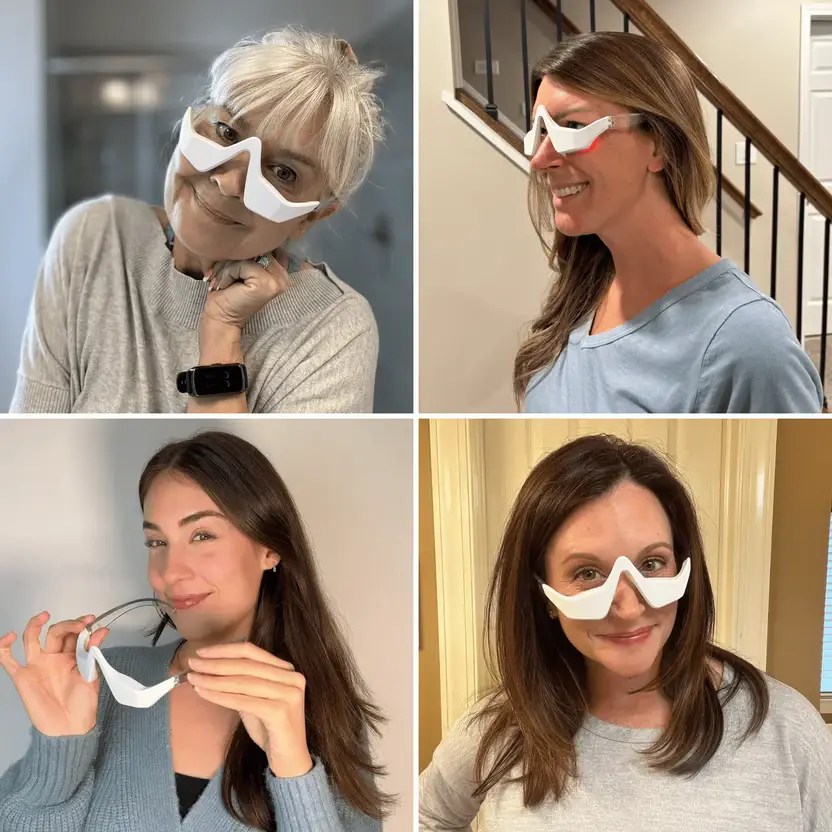
After evaluating several devices on the market, the one I consistently recommend to patients who ask for an at-home option is the Botanique Paris RevitalEyes 2-in-1 Red Light Therapy + EMS Device. It combines both mechanisms — 630–660nm red light and precision EMS microcurrent — in a form factor designed specifically for the eye contour area, where the skin is thinnest and most vulnerable to misapplication.

- Clinical-grade 630–660nm red light wavelength — the proven therapeutic range for collagen stimulation
- EMS microcurrent tones orbicularis oculi muscle and activates lymphatic drainage
- Designed for the periorbital contour — precisely shaped for under-eye, crow's feet, and brow-bone areas
- 5-minute daily treatment — integrates into any existing skincare routine
- Safe for all skin tones — no UV, no heat damage, non-invasive
- Results documented as early as 2 weeks with measurable improvements by week 8
What to Expect: Your Week-by-Week Timeline
One of the most important things I tell patients is to calibrate their expectations correctly. Unlike a hydrating cream that can produce an immediate surface plumping effect, red light therapy and EMS work by stimulating biological processes that take time to manifest visibly. This is a feature, not a bug — it means the results reflect genuine structural change, not temporary surface illusion.
RevitalEyes Results Timeline — Weeks 1 Through 8
Foundation Phase: Cellular Activation
Red light begins stimulating mitochondrial ATP production in dermal fibroblasts. EMS activates lymphatic pathways. Most users notice reduced morning puffiness within the first week. Surface skin texture may begin to feel smoother. Some notice a subtle improvement in skin tone evenness.
Remodeling Phase: First Visible Changes
New collagen synthesis begins producing measurable increases in dermal density. Fine lines around the eye begin to soften as dermal volume improves. Under-eye area appears less hollow. Puffiness reduction becomes consistent rather than variable. Approximately 70% of users report noticeable change at this stage.
Consolidation Phase: Firming and Lifting
Cumulative collagen increase produces visible firming in the periorbital area. Orbicularis oculi muscle tone improvement becomes apparent as a subtle lifting effect at the outer eye corners. Crow's feet appear visibly shallower. Skin elasticity improves — the "snap back" quality of the under-eye skin is often noted by users at this stage.
Transformation Phase: Full Results Apparent
The full extent of structural remodeling becomes visible. Clinical studies document peak results at the 8-week mark. Under-eye hollowing visibly reduced. Wrinkle depth measurably decreased. Skin tone and luminosity improved. The majority of users who complete the 8-week protocol report results they describe as comparable to professional in-office treatments at a fraction of the cost.
I want to be direct about one thing: consistency is non-negotiable. Five minutes daily for eight weeks. Patients who use the device three or four days a week and expect the same outcome as daily users are setting themselves up for underperformance. Red light therapy and EMS are dose-dependent — the cumulative exposure is what drives the biological response. Think of it the way you'd think of physical exercise: the benefits compound with regularity.

Real Patients, Real Results
"I spent fifteen years and probably $8,000 on eye creams. I saw more change in the under-eye area in six weeks with RevitalEyes than I did in all those years combined. The puffiness I'd woken up with every single morning since my forties is genuinely gone. I feel like I owe this thing an apology for doubting it."
"My crow's feet were something I'd accepted as permanent. I'm 47 and I have an active outdoor life. After eight weeks I compared photos side by side and couldn't believe the difference in depth. My husband noticed before I even said anything. That's when you know it's real."
"I was deeply skeptical — I'm a nurse and I know how the skin works. I bought it fully expecting to return it. By week three I was converting my skeptic colleagues. The science is real, the results are real, and the 365-day guarantee made the decision completely risk-free. Worth every penny at twice the price."
Ready to Treat the Source — Not the Surface?
Join over 300,000 women who've made the switch from topical guessing to targeted subdermal therapy. Currently 50% off the regular price — backed by a full 365-day money-back guarantee.
Claim Your 50% Discount on RevitalEyes $79.95 (was $159.99) · 365-Day Money-Back Guarantee · botaniqueparis.comThe Risk Reversal: Why There Is No Reason Not to Try This
Here is the argument I make to every patient who is still on the fence: What is the actual risk? Botanique Paris backs every RevitalEyes device with a 365-day money-back guarantee — an entire year. That is not a marketing gimmick. That is a company with extraordinary confidence in their product's ability to produce results that are visible and meaningful enough that customers don't ask for their money back.
Compare that to the eye cream sitting in your bathroom right now. Did it come with a satisfaction guarantee? Did the department store offer to refund you a year later if you didn't see results? Of course not. The eye cream industry operates on hope and beautiful packaging. The guarantee industry — the one that says "try it for a year and return it if you're not satisfied" — can only exist when the product consistently works.
At the current promotional price of $79.95 (reduced from $159.99), RevitalEyes costs less than most single-use professional treatments and less than many premium eye creams. The difference is that those creams will be empty in 60 days and you'll need to rebuy. A device is a one-time investment in a mechanism that works with your biology rather than sitting on top of it.
RevitalEyes by Botanique Paris
The dual-mechanism device that bypasses the surface barrier and addresses under-eye aging where it actually originates.
4.8-Star Rating · 300,000+ Customers
- 630–660nm Red Light + EMS Microcurrent
- Reaches the 2–3mm fibroblast layer
- One-time $79.95 (50% off)
- 365-Day Money-Back Guarantee
- Free Shipping · No Subscription
SSL Encrypted Checkout · Free US Shipping · botaniqueparis.com